The Judge's Seat
- Why did Amnesty's 'Strange Trial' campaign put participants in the judge's seat instead of the audience?
- Why are people more moved by conclusions they reach themselves than by ones they're told?
- How does 'the desire to be a better version of yourself' work inside a participatory campaign?
- What should an interactive video campaign actually be designed to do?
- What do participatory campaigns tend to miss after the moment of participation ends?
People who hear a conclusion nod. People who reach one move. In the Strange Trial, we didn't design a message. We designed the moment someone hands down their own verdict. What moved them in that moment wasn't logic. It was the wish to be a better judge — a better version of themselves.
Climate campaigns have a familiar grammar by now. Melting glaciers. A polar bear adrift on a shrinking floe. A chart climbing too steeply. And at the end, the same line: "Act now." None of it is wrong. The problem is that everyone already knows it.
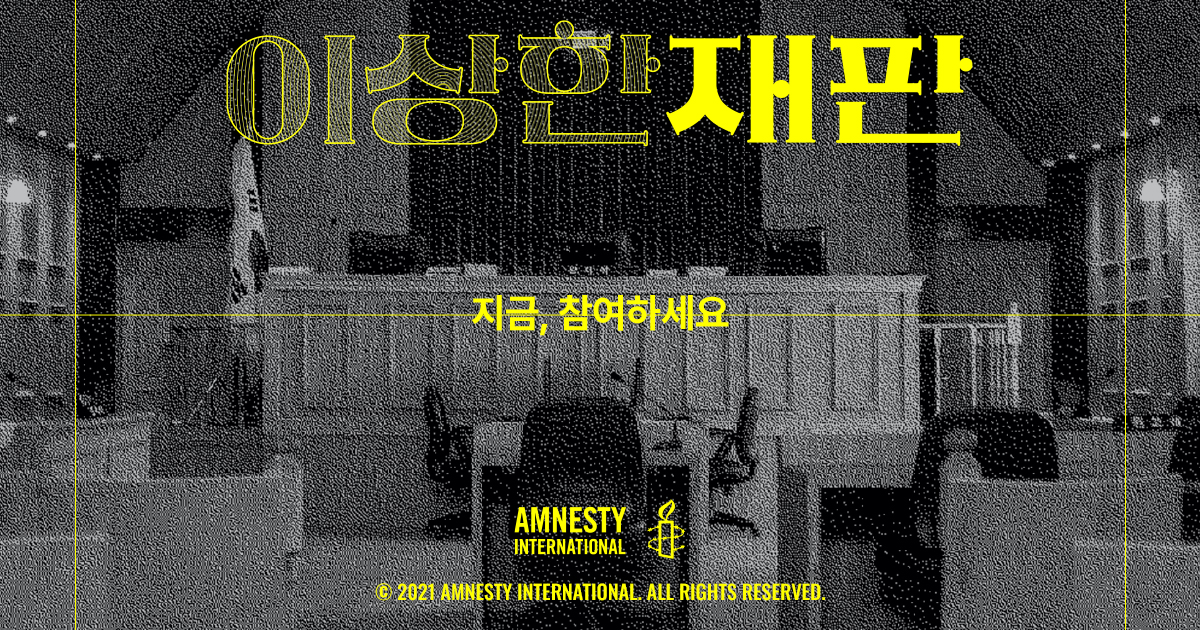
On July 23, 2021 — one hundred days before COP26 — Amnesty International Korea launched Strange Trial, a campaign on climate change and human rights. The question we lived with longest wasn't what to say. It was how to make people hear, truly hear, something they'd already been told a hundred times. Information wasn't the shortage. Plenty of people had already heard the conclusion that we face a climate crisis. Almost no one had reached that conclusion themselves.
Knowing something and believing it are not the same act. For most people, the climate crisis sat in the folder marked known — heard on the news, seen in a campaign, nodded at. That conclusion is accurate but weightless. It was never theirs to begin with. Saying the same conclusion to them one more time, louder, does nothing to add weight to that folder.
So we removed the audience seats. We put in a judge's bench instead. The opening line read: "Press start, and you become the judge of this trial."
A trial withholds the verdict
A trial is a form that defers its conclusion. An ad states its conclusion in the first frame. A trial withholds its verdict until the very end. There's testimony. Evidence. Objections. Only after all of it does someone hand down a judgment. That deferral — that withholding — was the structure we wanted to borrow. A conclusion has to stay suspended for someone to listen all the way through.
There were other participatory formats we could have chosen. Quizzes. Petitions. Personality tests. But a quiz already has a correct answer, and a petition already has its conclusion. The participant either guesses right or adds their name to a sentence someone else wrote. A trial was different. A judge isn't someone who guesses the answer — they're someone who makes one. What we were looking for wasn't a format that asked for participation. It was one that demanded judgment.
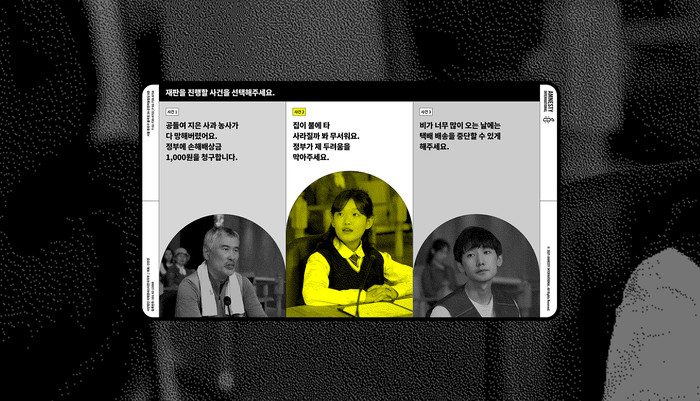
There were three cases. An apple farmer whose harvest, carefully tended for a full season, was wiped out by an unseasonal cold snap. A second-grader who, after watching a hillside catch fire twice near her home, is afraid her house will be next. A delivery worker gasping through a soaked mask in a downpour, still working. All three were fiction, drawn from real climate litigation abroad and real cases at home. No polar bears. No glaciers. Neighbors, instead. Moving the climate crisis from a distant landscape to the house next door — that was the standard behind every case we chose.
And each plaintiff's demand was, in its own small way, strange. One won. A one-thousand-won damages claim. A request that the government shield a child from her own fear. An ask to simply stop deliveries on days of heavy rain. That's where the quotation marks in the campaign's Korean title came from — a 'strange' trial. A strange demand makes you pause. The moment someone asks, "Why only a thousand won?" — they've already stepped inside the case.
It wasn't only the demands that were strange. What we wanted to say, through the plaintiffs' voices, was that it is strange — genuinely strange — that extreme weather is still filed away as an unavoidable act of nature. The farmer's thousand won wasn't compensation. It was confirmation — a request, in the language of law, that this responsibility belongs to the government, not to the individual who happened to be standing in the field. Strange Trial was, in the end, a title aimed at strange weather — and at our habit of never finding it strange at all.
Nobody obeys a verdict they only heard
There's a paradox built into persuasive messaging. The clearer the conclusion, the harder the listener defends against it. "Act now" is correct, but its very correctness builds a wall. When someone else reaches a conclusion on your behalf, it stays theirs — permanently.
What changes a person most deeply isn't someone else's argument. It's the argument they build for themselves. Once someone has taken a position on their own, they tend to act in ways that don't contradict it — especially when the decision was active, effortful, and left some kind of record.
But I think the engine that actually drives self-persuasion runs on desire more than logic. Someone sitting at the judge's bench doesn't calculate the correct verdict first. They want, first, to be a good judge. Someone who hears the aggrieved out to the end. Someone fair in the face of evidence. Someone who doesn't look away from the weaker side. Goodness, before it's an obligation imposed from outside, is a self-image a person wants to become. Goodness, too, is a desire.
Behavioral economics has a concept for this: diagnostic utility. People learn who they are by observing what they do. A verdict is a conclusion about the case and, simultaneously, evidence about the self. The moment a judge selects "Pay the damages," they're not only ruling for the farmer — they're telling themselves something: I am someone who rules this way. The shift in belief happens in that act of self-recognition.
I want to give this principle, discovered through the campaign, a name: Judge's Seat Design. Not handing someone a conclusion, but designing the seat from which they'll reach one themselves. More precisely: designing a seat from which, through the act of judging, a person can choose a better version of themselves. The work isn't making the message louder — it's moving the position of the person receiving it. From audience to judge.
The same information reads differently once the seat changes. To an audience, an IPCC report is one more frightening set of numbers. To a judge, the same report is evidence required for a ruling. An audience consumes information. A judge examines it. None of the evidence we put into the campaign was new. What was new was the position of the person looking at it.
The thing we guarded against most, in designing the judge's seat, was raising our voice. The moment we laid a swelling score under a plaintiff's testimony, or pushed a tearful backstory at the judge, the bench reverted to a theater seat. A verdict pushed through by emotion isn't the judge's verdict — it's the director's. So testimony stayed plain. Evidence stayed dry. The act of judging had to belong entirely to the judge.
People are rarely moved by a verdict they only heard. They are bound by the one they signed.
Designing the bench
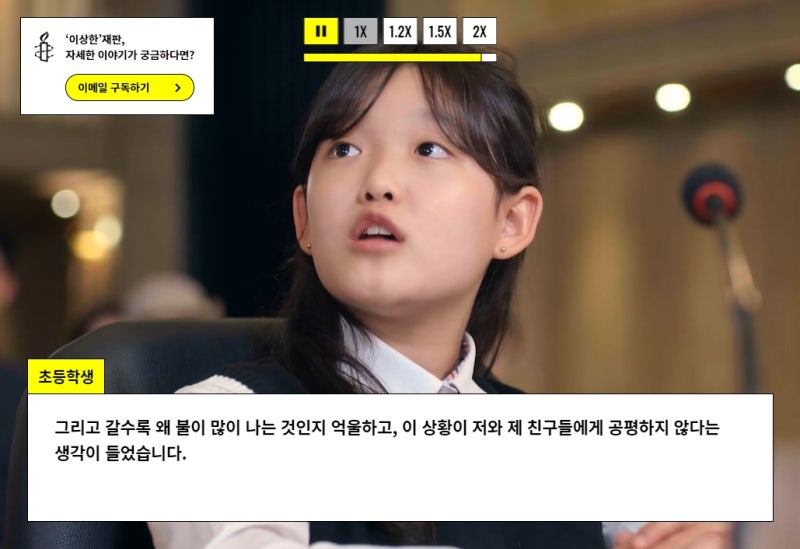
A judge's seat isn't built by declaration alone. Announce "You are the judge" and then simply play a video, and it's still an audience seat. For a judge to feel like a judge, actual moments of judgment have to arrive, again and again. So we shot the trial as a live-action film, with actors — and then stopped it, repeatedly. The next line of testimony would change depending on what the judge chose. Only when a judge feels their own call bending the course of the courtroom does the bench become a real seat.
After each testimony, the screen paused and asked the judge to choose their inner response. After the farmer's testimony: "Whatever the cause, the damage looks clear," versus "Not every year can be a good harvest. Isn't some of this on the plaintiff?" When the prosecutor shouted an objection, the judge had to decide — overrule it, or caution the defense. Wherever judgment required more, a button labeled View Evidence opened charts on agricultural disaster trends, wildfire statistics, the IPCC report, and a ruling from Germany's constitutional court.
The last step was the written verdict. In the blank line of the ruling, the judge chose between "Awarded" and "Not awarded" to complete the document. The date stamped on the ruling was the date of participation — today's date. A small device, but I've always liked it. The trial was fiction. The verdict, dated today, was something the judge had actually made.
Interactive video has always been a format I covet — and always one I distrust. The moment a choice becomes decoration, the video is just a video that keeps stopping. In this campaign, a choice couldn't be decoration. It had to be a duty. For a judge, an option isn't a feature. It's part of the job. Holding onto that distinction was the whole of the design work.
The three cases were written to demand three different kinds of judgment from the judge. The farmer's case is a case of loss: the damage is a clear number, and the question is who bears responsibility for it. The second-grader's case is a case of fear — the hardest question of the three, asking whether harm that hasn't happened yet can still be a violation of rights. The delivery worker's case is a case of labor: whether this is something an individual should simply be careful about, or something a system should be forced to stop. Whichever case a judge chose, they sat down across from a different face of the climate crisis.
A choice with one answer isn't a choice
The point we wavered on most, while writing the options, was whether to include a wrong answer. Given the campaign's purpose, it would have been safer to stack every option toward the plaintiff's side. But a choice with only one real answer isn't a choice at all. A judge who can't choose isn't a judge — they're a narrator.
So we left in the options that doubted the plaintiffs. "The plaintiff should have taken breaks and looked after their own health." "Isn't the fear of fire more of a personal problem?" These weren't lines we invented for a villain. They're thoughts many people actually have, quietly, when they hear a climate story. The campaign simply said them out loud first, and let the judge choose for themselves.
Freedom to doubt is what lets belief become one's own. A judge who doubted the plaintiff, then checked the evidence, then heard the rest of the testimony, and arrived — on their own — at "Awarded," has reached a conclusion that belongs to no one else. It carries far more weight than a verdict handed to them correct from the start. That's also why we left "Not awarded" standing as an option in the final document.
The desire to be good works most clearly right here. A path not taken only becomes evidence about the self when another path was genuinely open. A judge who could have blamed the plaintiff and didn't. A judge who could have looked away and heard it through instead. Becoming a better version of yourself requires, first, that a worse version was actually available to choose. Neuroscience research on choice itself functioning as reward (Leotti & Delgado, 2011) points the same way. Goodness only feels like a desire, rather than a duty, when the sense of having chosen it oneself is intact.
There was a reason for this decision beyond the campaign itself. The moment a judge doubts a plaintiff is, in fact, the moment society's quiet, unspoken thoughts about the climate crisis surface. Still, the individual should have been careful. The weather's always been unpredictable, hasn't it. Push people who think this way outside the campaign, and the campaign becomes applause among people who already agreed. The bench had to be a seat those people could sit in too — because the people who most need persuading are always the ones sitting in doubt.
A choice with only one answer isn't a choice. Belief becomes yours only when doubt was allowed.
The trial was fiction. The climate isn't.
Once the verdict is submitted, the screen changes. "This trial is fiction. The climate crisis is not." Then, layered over each of the three cases, a real one appears. In February 2021, a Paris administrative court found the French government responsible for the climate crisis and ordered one symbolic euro in damages. In September 2020, six Portuguese children and young people filed a climate suit against 33 European countries. In December of the same year, around forty South Korean citizens — outdoor laborers, farmers, others — filed a petition with the National Human Rights Commission over the climate crisis.
The order of this reveal mattered. Show people reality first and then ask for a verdict, and the verdict becomes little more than an opinion about a news story. Ask for the verdict first, and show reality after, and reality becomes a case that confirms a verdict already made. The one-euro ruling in Paris is no longer a distant piece of foreign news — it's the same conclusion the judge reached, moments ago, on their own.
Fiction is the practice court. Reality is the scorecard. Only someone who has already rendered a verdict on the practice bench reads the real verdict as their own business. The moment that strange number — one thousand won — overlaps with a real number — one euro — the campaign's design finally completes its circuit.
The case of the second-grade plaintiff works the same way. A judge who weighed a verdict while listening to a child's testimony — "If I live to ninety, I'll still be alive in 2100" — then encounters the fact that young people in Portugal sued thirty-three European countries. The fear that had, moments earlier, looked like a strange demand turns out to have already been argued in a real courtroom. What was strange, it turns out, was never the demand. It was my own instinct to find it strange.
10,000 judges, 7 in 10 verdicts
More than ten thousand judges sat on this bench. According to a media report the following year, of roughly 10,000 people who took part in the online mock trial, 70 percent ruled that the government bore responsibility for harm caused by the climate crisis. Amnesty's campaign team considered this evidence that the campaign had succeeded in reframing the climate crisis — not as a natural disaster, but as a consequence of human failure.
What I find encouraging in that number isn't only the 70 percent. It's the remaining 30. Three in ten judges reached a different verdict. That means the options doubting the plaintiff were never decoration — the bench was genuinely open. A trial where everyone reaches the same verdict isn't a verdict at all; it's a comprehension score. Because some judges chose a different path, the 70 percent who held the government responsible did so as a conclusion each of them reached on their own.
And that 70 percent isn't a conclusion the campaign told anyone. It's the result of ten thousand people hearing testimony, reviewing evidence, and signing their names to a ruling, one at a time. A number built, one wish to be a better judge at a time. The most persuasive message any campaign could offer, in the end, was this number — made entirely by the people who took part.
Seven in ten of 10,000 judges held the government responsible. No one handed them that verdict.
What the bench left undone
Looking back now, the shortcomings are clear. The first is the slope of the options. Even with 30 percent reaching a different verdict, I have to admit the two choices in nearly every scene didn't carry equal weight. One side spoke with the voice of a reasonable judge. The other spoke with the voice of someone blaming the victim. The judge could choose — but it was already obvious which choice they should make. When the answer is too obvious, the choice reveals nothing about the self. A judge who picks the answer anyone would pick hasn't confirmed a better version of themselves — they've simply gotten the question right. Had we put real dilemmas on the table — the cost of climate action, jobs, energy prices, questions where both sides carry genuine weight — the verdict would have landed heavier, and stayed longer.
The second is the prosecutor. Nearly every objection rested on a single line of argument — "there is no evidence" — which the defense then rebutted with evidence, every time. A weak rebuttal makes for a weak verdict. A trial that's easy to win doesn't hold a judge for long. If we wanted the bench to be real, the prosecutor needed lines capable of actually shaking the judge.
The third is what comes after the verdict. The next role we offered a judge who had just submitted their ruling was newsletter subscriber. The offer to keep sending them accessible stories on climate and human rights was sincere, but small — far too small for someone who had just stepped down from a bench. The fair judge disappeared the moment the verdict was filed, and all that remained was an anonymous name on a mailing list. The ledger of goodness closed with a single ruling. Someone who had just confirmed a better version of themselves needed a name and a role to carry that self forward. The moment self-persuasion burns hottest is right after the verdict. Had there been some mechanism to carry that heat into action before it cooled — turning the verdict itself into a petition, say — the distance between the bench and real action would have been far shorter.
Fortunately, the bench didn't disappear once the campaign ended. In 2023, Amnesty re-released the site as an introductory resource for climate justice education, with guidance for schools and clubs to rule on the cases together, then adapt them into in-person mock trials, assigning roles of judge, lawyer, prosecutor, and plaintiff based on the material. A bench once sat alone became a discussion table in a classroom. The 'seat after the verdict' we never fully designed inside the campaign seems to have gone looking for itself, through the form the bench had already built.
The fourth is length. Even a single case carries several rounds of testimony, choice, and evidence review. The moment of verdict arrives for someone who stays seated to the end. It never arrives for someone who gets up halfway through. We added a speed control to the video as a trace of this worry. The weight of the bench and the threshold for participation pulled against each other, and we never fully found the balance between them.
You can't make the decision. You can build the moment.
The largest thing this campaign left me with is this: a campaign doesn't have to be the act of delivering a conclusion. It can be the act of designing the moment a decision happens. You can't make someone's decision for them. But you can build the seat from which they come to make it — its height, the evidence laid in front of it, and the reality waiting to arrive behind it.
And what moves a person in that seat isn't guilt. "If you don't act, you too are responsible" puts people on the defensive. "What kind of verdict are you someone who hands down?" tips them forward. The first demands goodness. The second offers a chance to desire it. What Strange Trial did was the second.
This principle isn't unique to climate. It applies to most subjects nonprofit campaigns take on — poverty, discrimination, refugees, child protection. People already know the conclusion, and that's exactly why they no longer respond to it. The more familiar the subject, the less it needs a louder conclusion — and the more it needs a seat from which to reach one. A judge's bench doesn't have to look like a courtroom. It can be built from a single question, a single choice, a single sentence with someone's own name signed at the bottom. What matters isn't the form. It's who holds the subject position of the decision, in that moment.
The climate crisis is still a story everyone already knows. Which is exactly why a campaign that simply states the conclusion again is no longer enough. What's needed is putting people back on the bench. Showing them evidence. Letting them hear the counterargument. And then, quietly, handing them the pen. With that pen, people write the verdict of the case — and, at the same time, write down who they are.
Every verdict is also a verdict on the judge. Give people the bench, and they'll choose to be better.